LAFER is a research laboratory dedicated to the development of experimental, theoretical, and numerical
activities in Liquid crystal Nonlinear Optics and robust phenomena.
Our work focuses particularly on dissipative structures, complex spatiotemporal dynamics, and defect dynamics
that emerge in spatially extended optical systems.
Nonlinear optics is currently one of the most active areas of research in Physics and Engineering.
Since the discovery of the laser in the 1960s, which enabled the exploration
of material responses under high intensity electromagnetic fields, the field has expanded substantially.
Today, it encompasses both fundamental studies of light-matter interactions and applied research in the
cutting edge domains of future technologies, such as photonics, optical communication systems,
information storage and processing, biomedical imaging and art diagnostics, among others.
LAFER was founded in mid-2012 through a joint French–Chilean initiative supported by the bilateral project
Agence Nationale de la Recherche (ANR-39) and
Comisión Nacional de Investigación Científica y Tecnológica (CONICYT) .
Additional financial support was provided by FONDECYT,
the Facultad de Ciencias Físicas y Matemáticas, Universidad de Chile,
and the Departamento de Física, Universidad de Chile.
The laboratory was established and consolidated through the scientific collaboration of international partners,
including Stefania Residori and Umberto Bortolozzo from the Institut Non Linéaire de Nice (INLN, Nice, France),
as well as Eric Louvergneaux (Lille, France).
At present, the laboratory receives continued funding from FONDECYT
and the Millennium Institute for Research in Optics (MIRO).
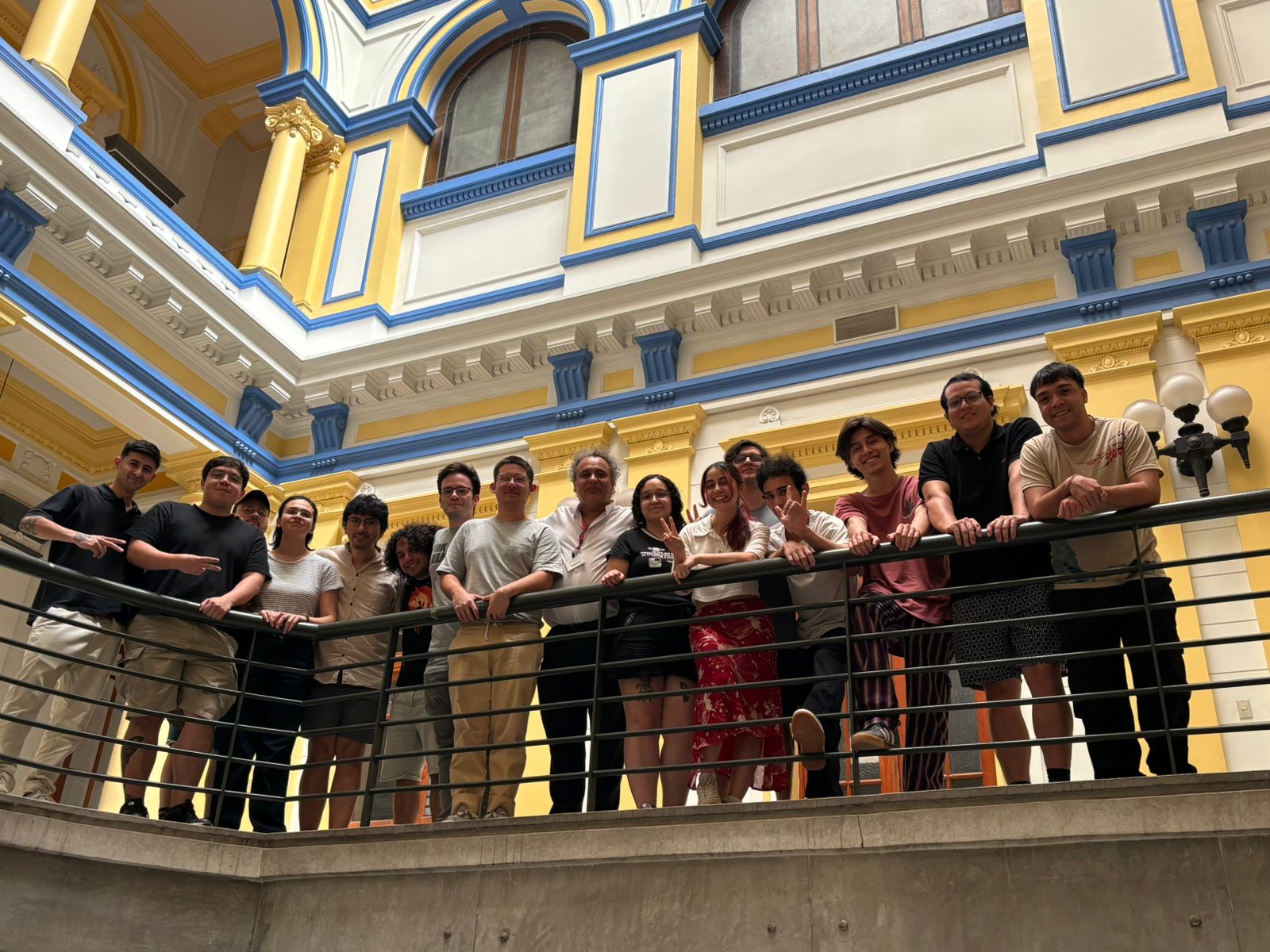
Our facilities


LAFER is located in the basement of the DFI building and comprises two laboratory rooms with areas of 20 m² and 40 m².
The facilities include three vibration-isolated optical tables (two 1 × 2 m and one 1.5 × 3 m)
equipped with active isolation systems. The laboratory is equipped with a Verdi V2 CW single-mode green laser (532 nm), a diode-pumped solid-state green laser (532 nm),
three red probe lasers (Thorlabs 24 mW CW at 630 nm and a Cobolt single-frequency compact laser module at
633 nm, 70 mW), and a Cobolt modulated laser diode at 445 nm (80 mW).
Instrumentation includes six motorized CCD cameras, three transmission spatial light modulators (Holoeye, 400 × 720 pixels),
two bipolar amplifiers (Tabor Electronics), and three optical microscopes equipped with CCD cameras.
Additional equipment comprises optical analyzers, a temperature-controlled microscopy stage (Linkam LTS350E),
and polarization-resolved microscopy systems (Olympus BX51 and Leica DM2700P) optimized for liquid-crystal
experiments. The laboratory also maintains four dedicated workstations for experiment control and data acquisition,
together with an extensive collection of optical components—mounts, beam splitters, polarizers, filters,
and lenses—amounting to several tens of thousands of USD in optics. These resources enable the rapid assembly
of custom experimental setups, including nonlinear optical valves with delayed and nonlinear feedback implemented
through fiber bundles.
Numerical simulations are performed on two high-performance workstations,
enabling large-scale computations with high spatial resolution and extended integration times,
which are necessary to accurately capture the complex spatiotemporal dynamics of the studied systems.